Engineering Atmosphere: The Practical Case for Olfactory Design in Commercial Architecture
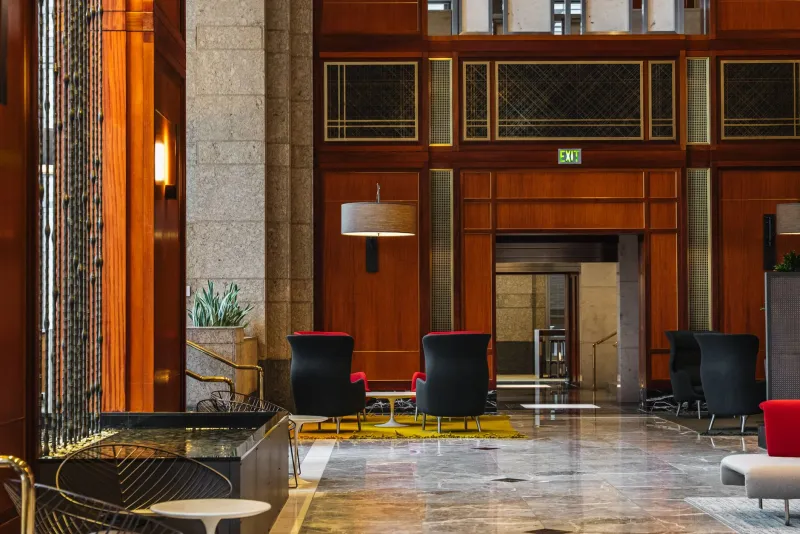
For decades, the architecture profession has organized its sensory ambitions around the visual. Light, material texture, spatial proportion, color—these are the instruments most designers reach for instinctively. The remaining senses have received far less disciplined attention, and none has been more consistently overlooked than smell. That oversight is increasingly difficult to justify.
Research in environmental psychology has established that olfactory experience shapes mood, memory formation, and behavioral response with a directness that no other sense can match. The nose connects to the limbic system—the brain's emotional and memory center—through a neural pathway that bypasses the cognitive filters that mediate other sensory inputs. In plain terms: a person who enters a space can rationalize what they see, but they cannot easily rationalize what they smell. The emotional response arrives first, and it is durable.
For architects and their commercial clients, this is not an abstraction. It is a design specification opportunity that most projects leave unrealized.
Why "Scent Design" Has a Credibility Problem
The idea of designing for smell carries, for many practitioners, an association with retail gimmickry—the cloying signature fragrances pumped through casino ventilation systems or the synthetic vanilla deployed in fast-casual restaurants. That association is not entirely undeserved. When scent is treated as a marketing overlay rather than an architectural element, the results tend to be manipulative in character and short-lived in effect.
The distinction worth drawing is between scent as a brand tool and scent as an environmental condition. The former is the province of marketing departments. The latter belongs to the architect. Intentional olfactory design, in the architectural sense, is concerned with controlling the olfactory baseline of a space: eliminating unwanted odors through material selection and air management, and introducing or preserving ambient scent profiles that support the spatial program. The goal is not to perfume a building. It is to ensure that what occupants smell reinforces what the architecture is trying to accomplish.
The HVAC Specification as an Olfactory Decision
Every building has an olfactory character, whether or not anyone has thought carefully about it. That character is largely determined by the mechanical systems. HVAC design controls air exchange rates, filtration quality, pressure differentials between zones, and the degree to which odors migrate between programmatic areas. These are technical decisions with direct sensory consequences, and they deserve to be made in coordination with the broader design intent rather than in isolation.
In practice, this means specifying filtration systems capable of removing volatile organic compounds and particulate matter that carry unwanted odor signatures. It means designing positive pressure relationships in zones where scent control is critical—a law firm's reception area, a medical office's consultation corridor, a hotel lobby. And it means thinking carefully about air supply locations and diffuser placement, since the direction and velocity of airflow determines how scent distributes through a volume.
For projects where a specific ambient scent is desired—the clean mineral quality of a high-end spa, the subtle cedar note of a premium retail environment—diffusion systems can be integrated directly into the ductwork. These are not consumer-grade devices. Commercial-grade cold-air diffusion systems atomize fragrance oil into particles small enough to disperse evenly without settling on surfaces or creating localized intensity. They are specified in terms of coverage area, output rate, and fragrance oil compatibility, and they require the same coordination with the mechanical engineer that any other HVAC component would.
Material Selection and the Olfactory Palette
Beyond mechanical systems, the materials that constitute a space contribute directly to its smell. This is understood intuitively by anyone who has walked into a building clad in reclaimed Douglas fir or entered a space tiled entirely in natural stone. What is less commonly acknowledged is that this understanding can be made systematic.
Certain materials carry persistent, architecturally desirable scent profiles: untreated wood, natural leather, wool textiles, unsealed concrete. Others introduce scent liabilities that require active management: synthetic carpet adhesives, certain composite wood products, and low-quality paint formulations all off-gas compounds that contribute to the flat, slightly chemical smell that characterizes too many commercial interiors. Specifying low-VOC finishes and adhesives is now standard practice for indoor air quality compliance, but the olfactory dimension of that decision is rarely foregrounded in client conversations.
A more deliberate approach involves treating material selection as an olfactory composition. A reception area finished in white oak millwork, natural wool upholstery, and linen-wrapped acoustic panels will smell different—and better—than the same room finished in vinyl plank, polyester textile, and painted drywall. The scent profile of the former is subtle, warm, and consistent with a premium positioning. It does not announce itself. It simply raises the baseline.
Case Evidence: Where Olfactory Design Has Delivered
Several commercial project typologies have demonstrated the practical value of intentional olfactory strategy.
Hospitality projects—particularly full-service hotels and boutique properties—have been early adopters, largely because the competitive logic is transparent. Properties that have invested in coherent scent environments consistently report higher guest satisfaction scores on qualitative metrics related to comfort and cleanliness. The Westin's iconic White Tea fragrance, introduced in the early 2000s, became a case study in the hospitality industry precisely because guests began associating the scent with a specific quality of experience, creating a sensory brand anchor that advertising cannot replicate.
In the workplace sector, evidence is accumulating more recently. Research conducted at several US-based corporate campuses has found that workspaces incorporating biophilic elements—living plant walls, natural wood surfaces, controlled fresh air introduction—report higher employee satisfaction and lower self-reported stress than comparable spaces without those features. While the studies do not isolate scent as an independent variable, the olfactory contribution of these elements is inseparable from their broader sensory effect.
Healthcare design offers perhaps the most compelling case. The clinical smell of hospitals—disinfectant, synthetic materials, recycled air—has long been identified as a contributor to patient anxiety. A growing number of healthcare facilities in the US are addressing this directly through material substitution, improved air exchange rates, and the careful introduction of natural scent elements in waiting and recovery areas. Early results suggest meaningful reductions in reported patient anxiety scores.
A Framework for Specifying Scent Without Gimmickry
For architects approaching olfactory design for the first time, a few principles provide useful orientation.
Start with elimination. Before introducing any intentional scent element, audit the project for olfactory liabilities: adhesive choices, flooring materials, mechanical system defaults. Remove the problems before adding anything.
Align with the spatial program. The olfactory character of a space should support its function. A calm, slightly mineral baseline suits a financial services office. A warmer, wood-forward profile suits a creative agency. Neither requires a formal fragrance system—both can be achieved through material selection alone.
Specify at the system level. If a diffusion system is appropriate, it belongs in the mechanical specification, coordinated with the HVAC engineer, not sourced independently by the client after occupancy.
Set a threshold, not a statement. The goal of olfactory design is a space that smells right without smelling like anything in particular. The moment occupants consciously register a scent, the design has probably overreached.
Architecture that defines space and purpose does so through every sensory channel available. The profession has mastered light. It is becoming more fluent in sound. Smell remains the final, underspecified frontier—and the firms that address it systematically will deliver environments their clients can feel the difference in, even if they cannot immediately name why.